
This is an old revision of the document!
Table of Contents
What Is 3D Printing

Back in the old days one way to test out a physical design was to build it. If the cost of building the real thing was too expensive then you'd model the shape out of something more cost effective, like clay. And to be sure, the hands of a professional artist can be very, very good. But even the best human hands are only so good, what if you have some seriously rigid specifications for your model? What if you need accuracy down at the micrometer scale? Even if you think you've got the shape right, once your design hits the factory floor it's very costly if you find a flaw and have to stop production to re-tool the manufacturing process. This is how 3D printing got it's start, as a way to quickly prototype shapes using a cheap medium.

The first 3D printer was created by Charles W. Hull of 3D Systems Corporation in 1984. C.W. Hull is known as the father of the solid imaging process called “stereolithography” – or simply “3D printing” as we call it today. The Standard Tessellation Language (STL) file format invented by Hull is still widely in use today.
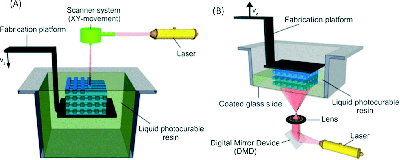
3D printers are machines that “print” three-dimensionally, CAD-rendered objects by precisely layering bits of material and then solidifying that material into a larger object. There are a number of ways that this is done, and the method chosen often depends on balancing price, material properties, and the speed and precision with which you can print:
- Stereolithography (SLA)
This process is the oldest process, and the process first developed by Hull. This process involves converting a liquid plastic into a solid using photopolymerization, a process by which light causes chains of molocules to link together forming polymers. Depending on the materials and methods used, once printed a model may require curing time under special conditions to finish the job.

Why Your Crazy IT Manager Thinks This Is Cool
Disclaimer
- NIMBioS IT staff will not take responsibility for your personal machine. The reader is expected to know how to administrate his or her own machine.
- The documentation above is merely for guidance. Menus, options, and commands presented may not match the reader's particular operating system, software, or versions.
- None of these documents have a brain. Readers are expected to provide their own.


