‘Think Differently,’ McPeek Urges

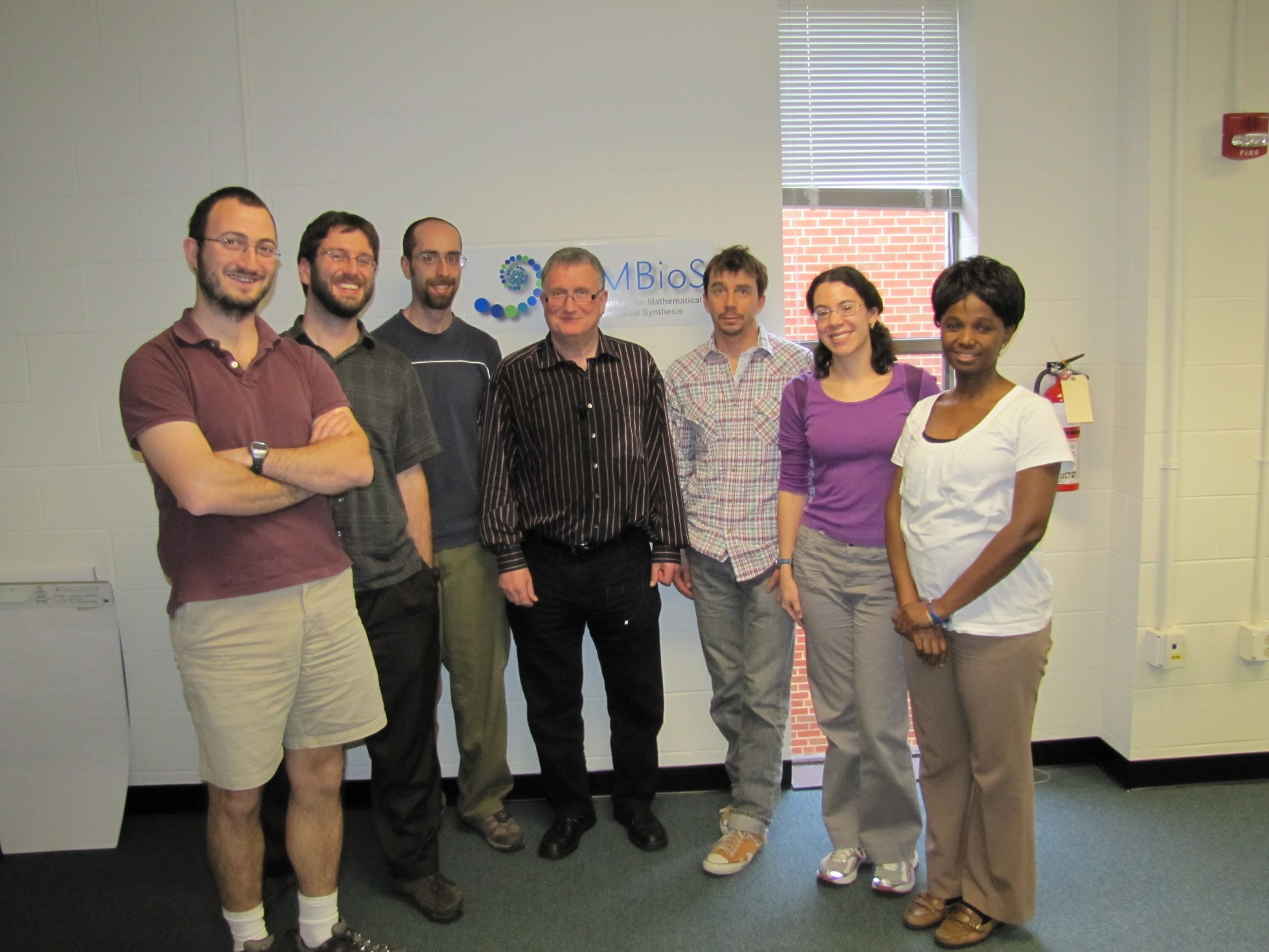
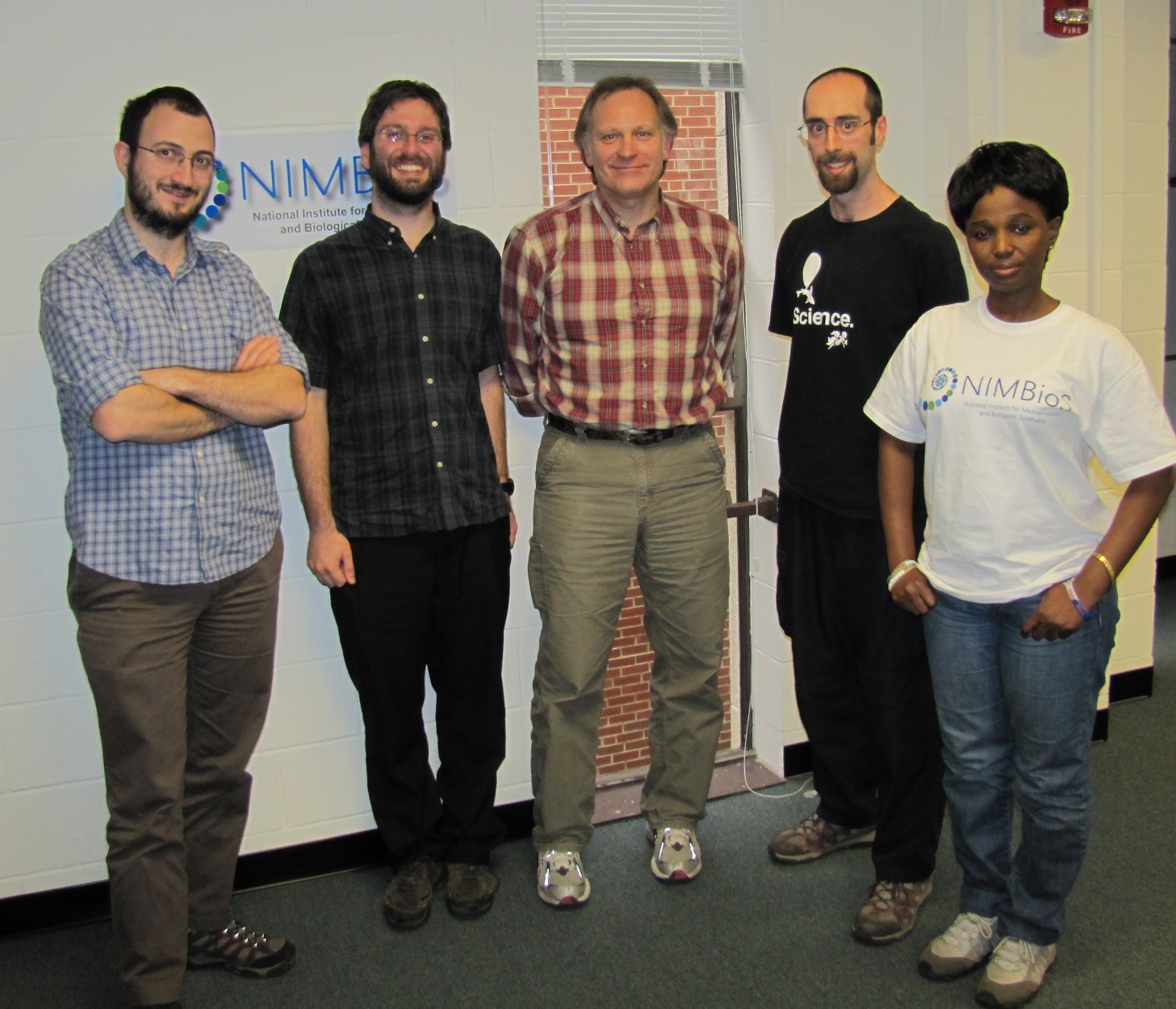
NIMBioS Postdoctoral Fellows Invited Distinguished Visitor Mark McPeek (center) visits with NIMBioS Postdocs, from left, Erol Akcay, Will Godsoe, Xavier Thibert-Plante, and Fola Agusto.

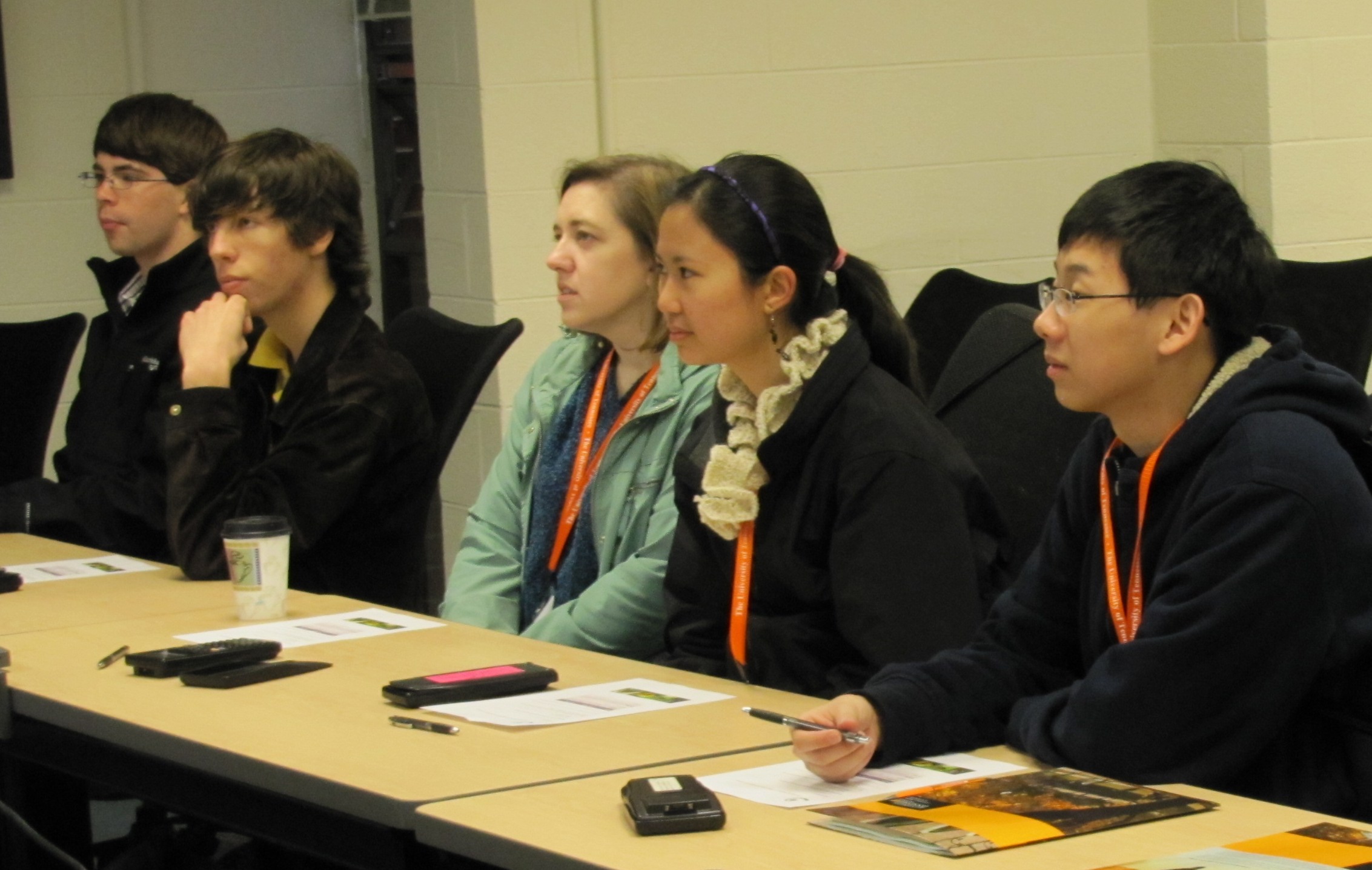
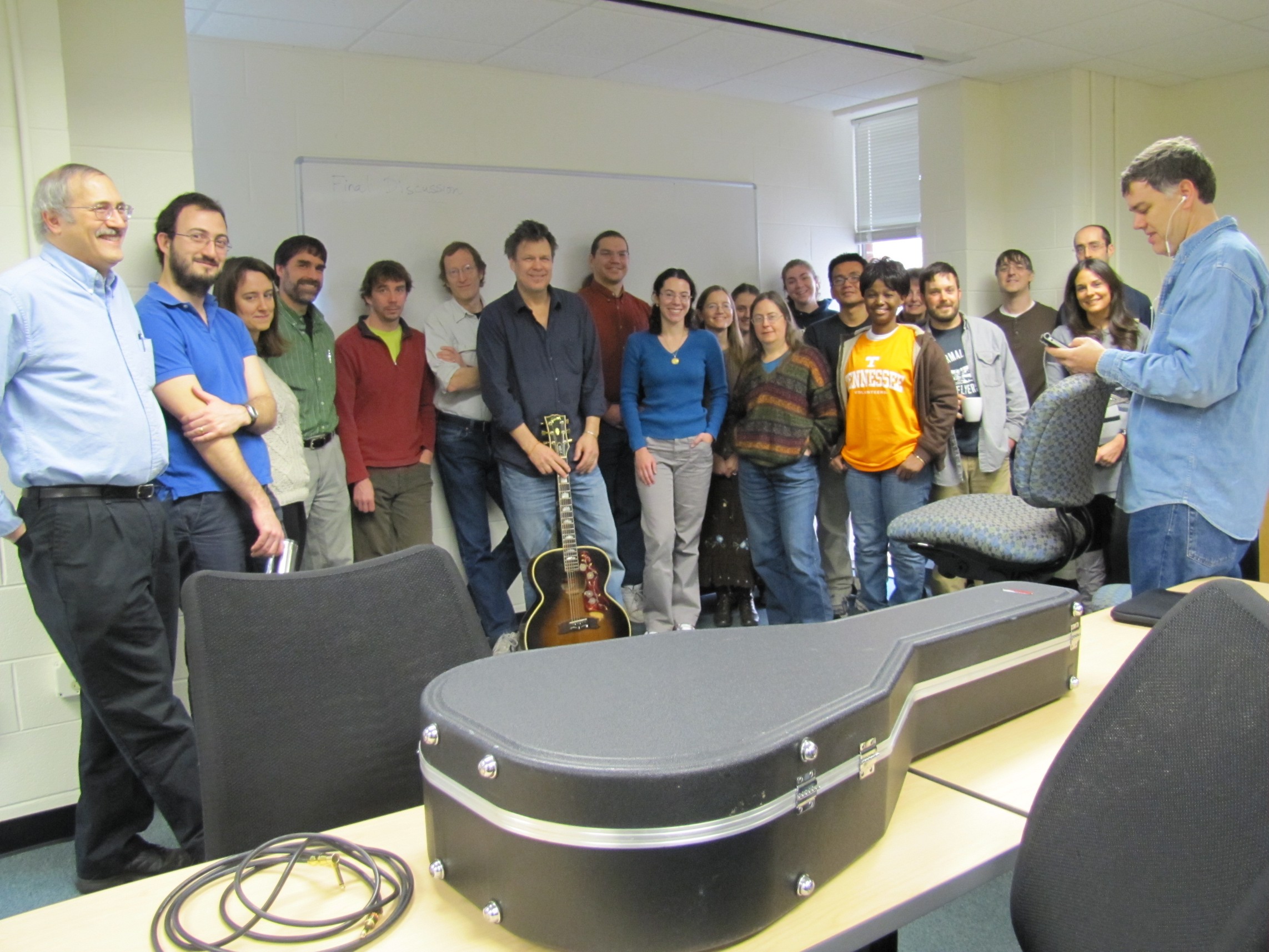
Theoretical ecologists should think about the world in a different way, said Dr. Mark A. McPeek, David T. McLaughlin Distinguished Professor of Biological Sciences at Dartmouth College, during Tuesday’s Interdisciplinary Seminar at NIMBioS. “Are our theories built for the right time?” was his question to the packed room — an audience of mostly faculty, postdocs, grad students, and undergraduates.

McPeek’s talk, Climate Change and How We Got the Biota We Have Today, used his research on the adaptation and diversification of Enallagma damselflies in North America over the past 15 million years to illustrate the consequences of continuous climate change. Most ecological and evolutionary theory, even theory built on stochastic dynamics, is formulated for an unchanging environment, he said. However, the history of the Earth is one of continuous climate change, and radical change at that over the past few million years.

With this in mind, McPeek urged scientific research to be more integrative and for scientists to consider all the possible disciplines that can influence any given metric a scientist might be interested in. McPeek was a NIMBioS Postdoctoral Fellows Invited Distinguished Visitor.


Posted in ecology, seminars | Tagged , , | Comments Off on ‘Think Differently,’ McPeek Urges

NPR-Affiliated Web Site Now Features News from NIMBioS

NIMBioS is pleased to announce that we now have our own branded blog on TalkingScience, the project of the Science Friday Initiative, the nonprofit partner of the radio program Science Friday, which is broadcast on NPR. The TalkingScience Web site features science news,  interviews with scientists, and intriguing science and technology stories across the Web.  The NIMBioS branded blog is called “Biology by Numbers” and will include videos, news stories, and educational content from NIMBioS. “Biology by Numbers” is one of several blogs on TalkingScience. Currently, “Biology by Numbers” features a video starring frequent NIMBioS visitor Rene Salinas about counting bears in the Appalachian Mountains. The Salinas video is also cross-posted on the “Dream Jobs” page. For Rene, we hope that is indeed the case!

According to its site, TalkingScience’s core mission is to:

  1. Cultivate enthusiasm for science and a desire for scientific literacy in the general public – particularly teens.
  2. Encourage young people to pursue STEM subjects in school, get involved with STEM-based extracurricular activities, and pursue careers in STEM fields.
  3. Support educators (teachers and parents) in their efforts to increase scientific literacy in the next generation.

Look for fresh NIMBioS content every month. If you would like to contribute to “Biology by Numbers,” contact NIMBioS Communications Coordinator Catherine Crawley at ccrawley@nimbios.org.

Posted in TalkingScience | Comments Off on NPR-Affiliated Web Site Now Features News from NIMBioS

Songwriter-in-Residence Jay Clark Debuts ‘Sexual Selection’

Americana musician Jay Clark, who was the NIMBioS Songwriter-in-Residence in January, was recently interviewed about his residency on the show Studio 865. He also performed his song, “Sexual Selection.” To hear other songs from NIMBioS Songwriters-in-Residence, visit https://legacy.nimbios.org/songwriter. Read more about the residency program here in Tennessee Today.

Posted in songwriter | Tagged | Comments Off on Songwriter-in-Residence Jay Clark Debuts ‘Sexual Selection’

Hammerstein Explains How Plants Manipulate Brains

NIMBioS Postdoctoral Fellows Invited Distinguished Visitor Peter Hammerstein (center) visits with NIMBioS Postdocs, from left, Erol Akcay, Will Godsoe, Xavier Thibert-Plante, Tucker Gilman, Emily Moran, Fola Agusto

Dr. Peter Hammerstein from the Institute for Theoretical Biology at Humboldt University in Berlin was NIMBioS’ Postdoctoral Fellows Invited Distinguished Visitor at Tuesday’s Interdisciplinary Seminar. Hammerstein investigates the evolution of living organisms using evolutionary game theory. In his talk, “Manipulative strategies and their evolution,” Hammerstein discussed how manipulative strategies affect the decisions of others to one’s own advantage. Using parallels in biology, Hammerstein discussed how microorganisms often manipulate regulatory networks of their hosts in ways that are “strategic” and are based on subtle interference with these networks. Taking the analogy further, Hammerstein gave examples of the ways in which plants, such as Nicotiana tabacum or cultivated tobacco, manipulate brains.

Posted in game theory, postdocs, seminars | Tagged , , | Comments Off on Hammerstein Explains How Plants Manipulate Brains

High School Scholars Connect Math and Biology Using Biodiversity

A group of Tennessee high school students and teachers learned about how math and biology converge during a visit to NIMBioS last week as a part of the Tennessee Junior Science and Humanities Symposium. The symposium is an annual event in which high school students present original research and compete for college scholarships. During their visit to NIMBioS, the students and their teachers learned about NIMBioS’ research and outreach goals and also took part in an activity that introduces an example of the interface of math and biology — how to derive and apply Simpson’s Index of Biodiversity. The 17 students and seven teachers were from Farragut High School (Knoxville), Pope John Paul II High School (Nashville), Oak Ridge High School (Oak Ridge), Webb School (Knoxville), White Station High School (Memphis), Cookeville High School (Cookeville), and Heritage High School (Maryville). The Simpson’s Index biodiversity lesson is publicly available here, as well as a more advanced module using real salamander data from the Great Smoky Mountain National Park.

Posted in Education/Outreach, STEM, Uncategorized | Tagged , | Comments Off on High School Scholars Connect Math and Biology Using Biodiversity

Science for the People!

NIMBioS Songwriter-in-Residence RB Morris performs his song “Science for the People.” For more information about NIMBioS’ Songwriter-in-Residence program, visit https://legacy.nimbios.org/songwriter

Posted in songwriter | Tagged | 2 Comments

Saving the Mighty Bat

(From left) Cory Holliday (The Nature Conservancy), Jeff Nichols (Oak Ridge National Laboratory), Tom Ingersoll (NIMBioS), Marcy Souza (UT College of Veterinary Medicine), Gary McCracken (UT), Alex Wyss (The Nature Conservancy), Roger Applegate (Tennessee Wildlife Resources Agency), Veronica Brown (UT), Hazel Barton (Northern Kentucky University), Tom Hallam (UT), Amanda Janicki (UT), Steve Samoray, Sterling Daniels (Tennessee Wildlife Resources Agency)

An informal gathering of scientists and wildlife experts interested in halting the spread of white-nose syndrome (WNS) gathered for a day-long discussion on Feb. 3. Talk centered around WNS epizootiology, dispersal and treatment of the disease. The meeting was organized by Thomas G. Hallam and Gary F. McCracken from the Department of Ecology and Evolutionary Biology at the University of Tennessee, Knoxville. Estimated to have killed over a million bats in a three year period, the disease is probably caused by a newly discovered cold-adapted fungus, Geomyces destructans. A new paper by Hallam and McCracken in Conservation Biology examines management options for the disease and finds culling is ineffective in controlling WNS. Hallam and McCracken organized the 2009 NIMBioS Investigative Workshop on Modeling White-Nose Syndrome, which laid the groundwork for the mathematical model on culling.

Posted in ecology, Wildlife | Tagged , | 1 Comment

Going Back to Skull with Biology in a Box

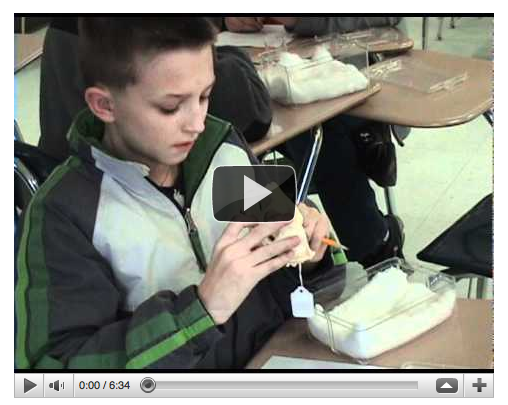
NIMBioS Communications Coordinator Catherine Crawley and NIMBioS Education and Outreach Coordinator Kelly Moran dropped in on students at Jacksboro Middle School in Campbell County, TN to film for an upcoming NIMBioS video about Biology in a Box. Seventh grade science teacher Gale Stanley led the students through a hands-on activity from Unit #2, Of Skulls and Teeth. Students handled skulls from a turtle, armadillo, bobcat, skunk, and many more. After counting each skull’s teeth, the students generated a frequency table of the number of incisors, canines, pre-molars and molars, and then answered questions about dental pattern differences between carnivores, herbivores and omnivores.

Posted in Education/Outreach, STEM, Wildlife | Tagged , , | 1 Comment

Residency Draws to Close With Mini-Concert

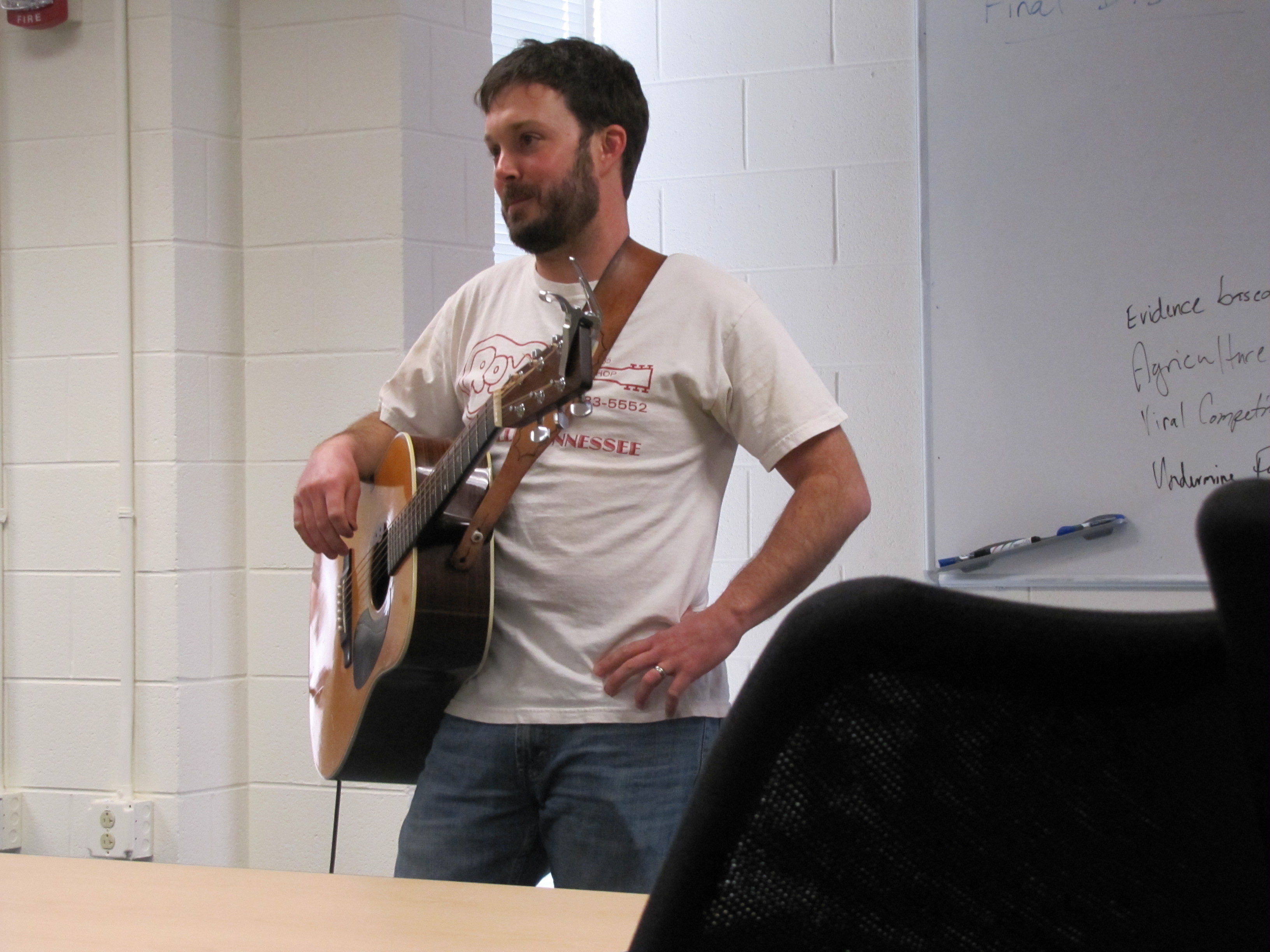
NIMBioS scientists and staff recently enjoyed a lunchtime performance of January Songwriter-in-Residence Jay Clark. Clark performed four songs from his repertoire and unveiled one of his songs from his residency, titled “Sexual Selection.” Clark’s residency finished at the beginning of February. Songs written during his time at NIMBioS will be available on our website soon.

Posted in songwriter | Tagged | 1 Comment

The Many Voices of Science

The NIMBioS crew gathered to sing RB Morris' Science for the People.

NIMBioS Songwriter-in-Residence RB Morris stopped by with crew from a local radio station to record a chorus of voices for his “Science for the People” song. NIMBioS staffers and scientists belted out the chorus to this catchy tune. And, yes, you guessed it, it echoes Lennon’s “Power to the People.” But, of course, this is science, and so Science To The People! Watch the video. Click on the link to hear a sample of the song, recorded LIVE at Laurel Theater on Friday, Jan. 18. Science for the People – RB Morris (with special thanks to Jay Manneschmidt for the recording and Stan White for the sound engineering).

Posted in songwriter, Uncategorized | Tagged | Comments Off on The Many Voices of Science