
Congratulations to New Recipients of Support

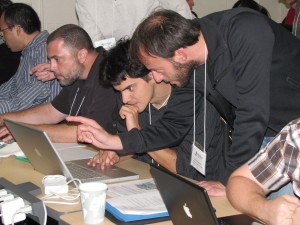
Renal function, a destructive disease in cattle, and an infection that can damage a growing human fetus are among the topics to be studied beginning in 2011 at NIMBioS. The range of topics to be investigated in new Working Groups and Investigative Workshops advance the Institute’s mission to foster new collaborative efforts to address biological questions using mathematical and computational methods. Researchers across multiple disciplines will comprise the newly formed Working Groups and Investigative Workshops. Investigative Workshops last from several days to one week and involve 30-40 participants, of which about half are invited, while Working Groups comprise about a dozen scientists who meet up to four times over the course of several years.

New Working Groups include the following:

  • Modeling Renal Hemodynamics (Organizers: Anita Layton, Dept. of Mathematics, Duke Univ. and Leon Moore, Dept. of Physiology & Biophysics, SUNY Health Sciences Center)
  • Modeling Johne’s Disease (Organizers: Shigetoshi Eda, Center for Wildlife Health, Univ. of Tennessee; Ynte H. Schukken, Dept. of Population Medicine and Diagnostic Sciences, Cornell Univ.; Ian A. Gardner, Dept. of Medicine and Epidemiology, UC Davis; John P. Bannantine, Agricultural Research Service, USDA)
  • Multiscale Modeling of the Life Cycle of Toxoplasma Gondii (Organizers: Zhilian Feng, Dept. of Mathematics, Purdue Univ.; Dana Mordue, Dept. of Microbiology and Immunology, New York Medical College; Chunlei Su, Dept. of Microbiology, Univ. of Tennessee; Xiaopeng Zhao, Dept. of Biomedical Engineering, Univ. of Tennessee)

The following Investigative Workshops will be held during 2011:

  • ‘Pretty Darn Good Control’: Extensions of Optimal Control for Ecological Systems (Organizers: Megan Donahue, Hawaii Institute of Marine Biology; Carl Toews, Dept. of Mathematics, Duquesne Univ.; Alan Hastings, Dept. of Environmental Science and Policy, UC Davis; Paul Armsworth, Dept. of Ecology and Evolutionary Biology, Univ. of Tennessee)
  • Optimal Control for Agent-Based Models (Organizers: Gary An, Univ. of Chicago Pritzker School of Medicine; Reinhard Laubenbacher, Virginia Bioinformatics Institute; Jie Xiong, Univ. of Tennessee)
Posted in awards | Tagged | Comments Off on Congratulations to New Recipients of Support

Forty Attend HPC Phylogenetics Tutorial

Our classroom is packed to capacity this week with 40 participants attending the NIMBioS Tutorial: High Performance Computing for Phylogenetics. This popular tutorial focuses on how to use TeraGrid, the CIPRES Portal, the iPlant Discovery environment, university clusters, and other typically free HPC resources for phylogenetic analysis. The tutorial is geared primarily toward biologists who are at least moderately experienced with phylogenetic analysis though other researchers, such as statisticians or mathematicians working in phylogenetics, are also participating. The tutorial runs today through Friday, Oct.  15. We are working to record sessions and make them available on the web for those who are interested.
Posted in Computing, Education/Outreach, Tutorial, Uncategorized | Tagged , | Comments Off on Forty Attend HPC Phylogenetics Tutorial

Visit from UT Interim President

UT Interim President Jan Simek stopped by the other day during our bi-annual Board of Advisors Meeting. Board member Ellis McKenzie (NIH) and Simek were roommates as freshman at UC Santa Cruz back in the day.

Posted in Board, Leadership | Tagged , | Comments Off on Visit from UT Interim President

Girls Get Their Hands Dirty at SHADES Workshop

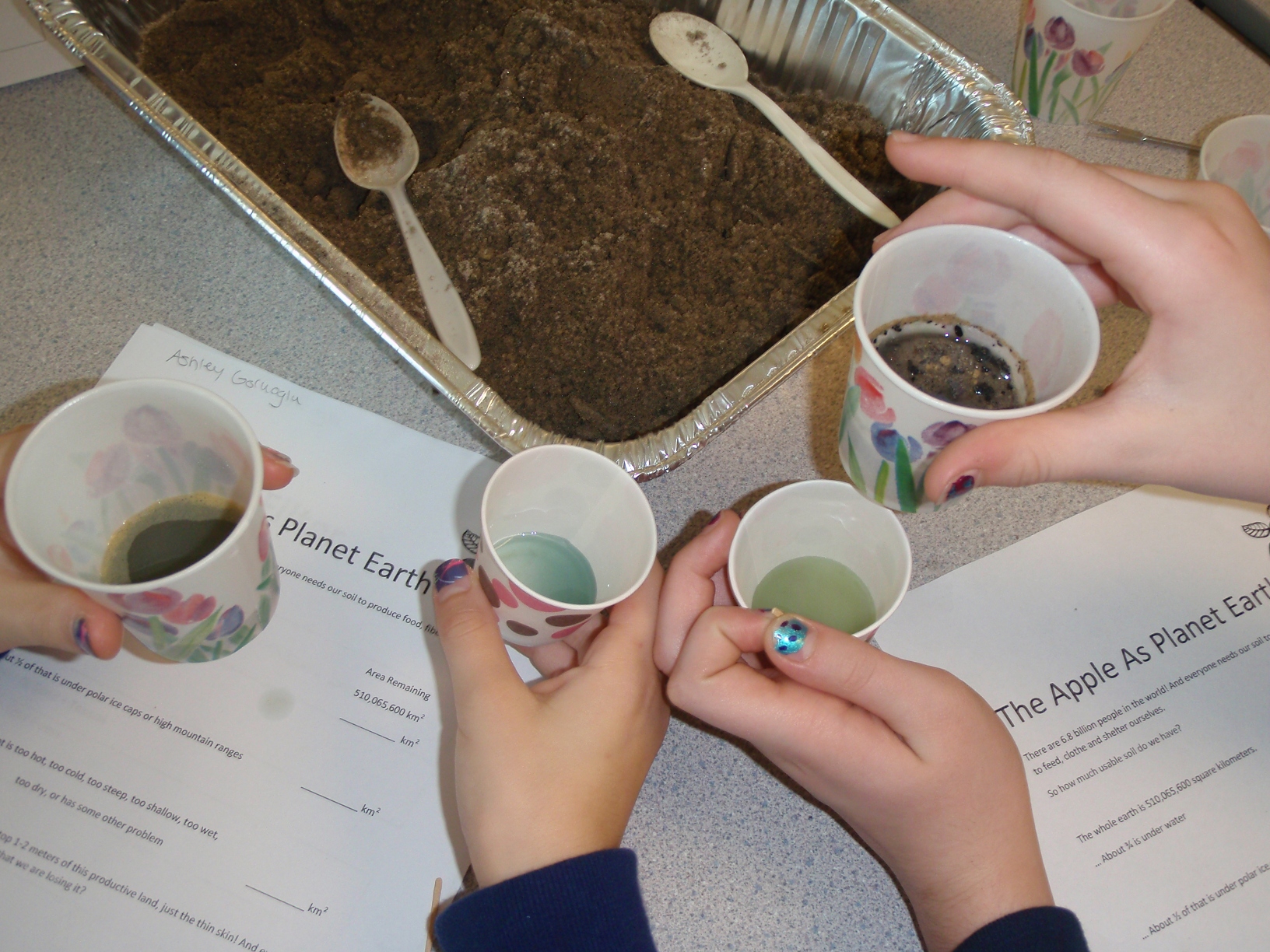
NIMBioS helped inspire sixth and seventh grade girls about careers in math, science and engineering at the annual Sharing Adventures in Engineering and Science (SHADES) workshop organized by the Greater Knoxville Math/Science Coalition last weekend. Thirty-eight local students got their hands dirty with an earth science activity demonstrating soil’s capacity as a filter for water. Also, using an apple as a model of planet earth, students calculated that the fraction of land available on earth to farm is actually pretty small, so therefore important to conserve. Students also completed a hands-on math activity called “Fun With Triangles.” Kelly Moran, NIMBioS education and outreach coordinator, and Jillian Trask, an alumna of NIMBioS’ Research Experience for Undergraduates and a doctoral student in mathematics at the Univ. of Tennessee, led the activities. The day culminated with an engineering design competition. Community members and teachers also attended.

Posted in Education/Outreach, gender diversity, STEM | Tagged , | 1 Comment

UT/NIMBioS Team Win International Award

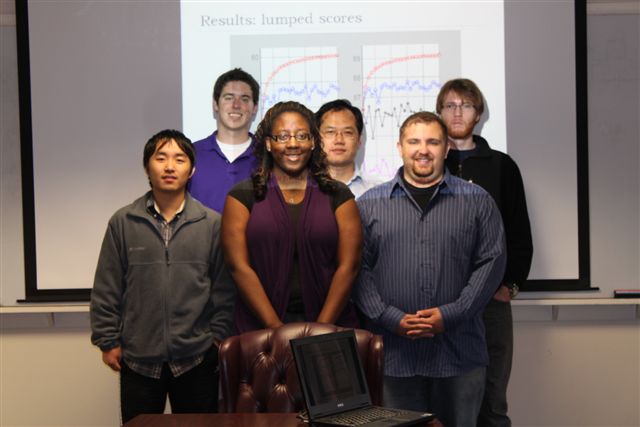
Back row, L to R: R. Matthew Wham, Xiaopeng Zhao, Joseph McBride. Front row, L to R: Henian Xia, Erica Hawkins, Adam Sullivan

A team led by NIMBioS senior collaborator and Univ. of Tennessee (UT) assistant professor Xiaopeng Zhao won second place in the Physionet/Computing in Cardiology Challenge 2010: Mind the Gap international competition. This year’s challenge called for participants to develop robust methods for filling in gaps in multiparameter physiologic data. These techniques have many potential applications ranging from sleep studies to surgery to sports medicine to intensive care. Fifty-three teams competed this year. A UT team from the Department of Mechanical, Aerospace, and Biomedical Engineering designed a technique combining neuron network models with a nonlinear feedback mechanism, which can achieve up to 89% of accuracy in data reconstruction. The team received a $500 cash award. The team included three graduate students: Joseph McBride, Adam Sullivan and Henian Xia (who is a NIMBioS Graduate Research Assistant) as well as two undergraduate students: Erica Hawkins and Robert Wham. The team was assisted by J. Wesley Hines, associate professor of nuclear engineering; Kivanc Ekici, assistant professor of mechanical, aerospace, and biomedical engineering; and Gerald Ragghianti of UT’s Newton High Performance Computing Program.

Posted in awards, Computing | Tagged | Comments Off on UT/NIMBioS Team Win International Award

Riechert Appointed by Governor to ‘Race to the Top’ Advisory Council

Susan Riechert, professor of ecology and evolutionary biology at the Univ. of Tennessee and senior NIMBioS collaborator, was recently appointed by Gov. Phil Bredesen to the Tennessee Science, Technology, Engineering and Mathematics (STEM) Advisory Council to help direct Tennessee’s strategic plan regarding placement of STEM initiatives and resources across the state in accordance with the federal “Race to the Top” K-12 education reform initiative. Riechert directs the Biology in a Box program, co-funded by NIMBioS.

Posted in awards, Leadership, STEM | Tagged , | Comments Off on Riechert Appointed by Governor to ‘Race to the Top’ Advisory Council

NIMBioS Researcher Links Maternal Genes to Selfish Behavior

The research of Francisco Úbeda, assistant professor of ecology and evolutionary biology and one of NIMBioS’ senior personnel, has been featured in the New York Times. The article discusses Úbeda’s mathematical model for assessing the consequences of a woman living in her husband’s village, among people to whom she is not related. His research, which is published in the current issue of Evolution, finds natural selection will favor the activation of paternal genes that underlie altruistic behavior and maternal genes that promote selfishness.

Posted in altruism | Tagged | Comments Off on NIMBioS Researcher Links Maternal Genes to Selfish Behavior

Thibert-Plante’s Study Selected for Faculty of 1000 Biology

A study about the detection of ecological speciation by NIMBioS Postdoctoral Fellow Xavier Thibert-Plante and McGill University Associate Professor Andrew Hendry has been selected by Faculty of 1000 Biology, a prestigious online research service that highlights the most interesting papers published in the biological sciences  as recommended by distinguished faculty members.

The study, When can ecological speciation be detected with neutral loci?, published in Molecular Ecology in June 2010 and selected by Faculty of 1000 in August, addresses the inconsistencies in measuring ecological speciation.

Thibert-Plante and Hendry used individual-based numerical simulations that focused on how population divergence at neutral loci varies in relation to recombination rate to a selected locus, strength of divergent selection at that selected locus, migration rate and population size.

Their findings have supplied insight into the value of using neutral markers to infer ecological speciation in natural systems, and will aid future interpretation of empirical studies.

Posted in awards, speciation | Tagged , | 1 Comment

NIMBioS Teams With Nautilus

The National Institute for Mathematical and Biological Synthesis (NIMBioS) will begin analyzing and visualizing massive amounts of data this fall using Nautilus, the world’s largest shared-memory computer.
The project is a part of NIMBioS’s collaboration with the Center for Remote Data Analysis and Visualization (RDAV) , which houses the supercomputer. The University of Tennessee (UT) recently received a $10 million grant from the National Science Foundation to establish RDAV.
“NIMBioS and RDAV have already initiated new collaborations to enhance the use of visualization for large datasets arising from field observations and from mathematical model results. Our objective is to increase the ability of biologists to interpret and analyze complex, multivariate data to address fundamental and applied questions in the life sciences,” said Louis Gross, NIMBioS Director and Professor of Ecology & Evolutionary Biology and Mathematics at the University of Tennessee. More here.

Posted in Computing | Tagged | Comments Off on NIMBioS Teams With Nautilus

More Bad Bat News

Little brown bat with white-nose syndrome. Credit: Marvin Moriarty/USFWS

First the good news: NIMBioS was pleased to see Winifred Frick’s research published in Science, Aug. 6, 2010. The lead author of the Science article (Frick) along with several other authors were at the first gathering dealing with modeling of white-nose held here at NIMBioS in June 2009. The Science Perspective on the topic is by Peter Daszak, who regularly participants in several NIMBioS activities. The bad news is of course that one of the most common bat species in North America, the little brown bat, now faces extinction (within 16 years) from white-nose syndrome, which has already killed a million bats in the northeastern U.S.

Posted in Wildlife, Workshop | Tagged , | Comments Off on More Bad Bat News